A Maxwell Leadership Mastermind Programme
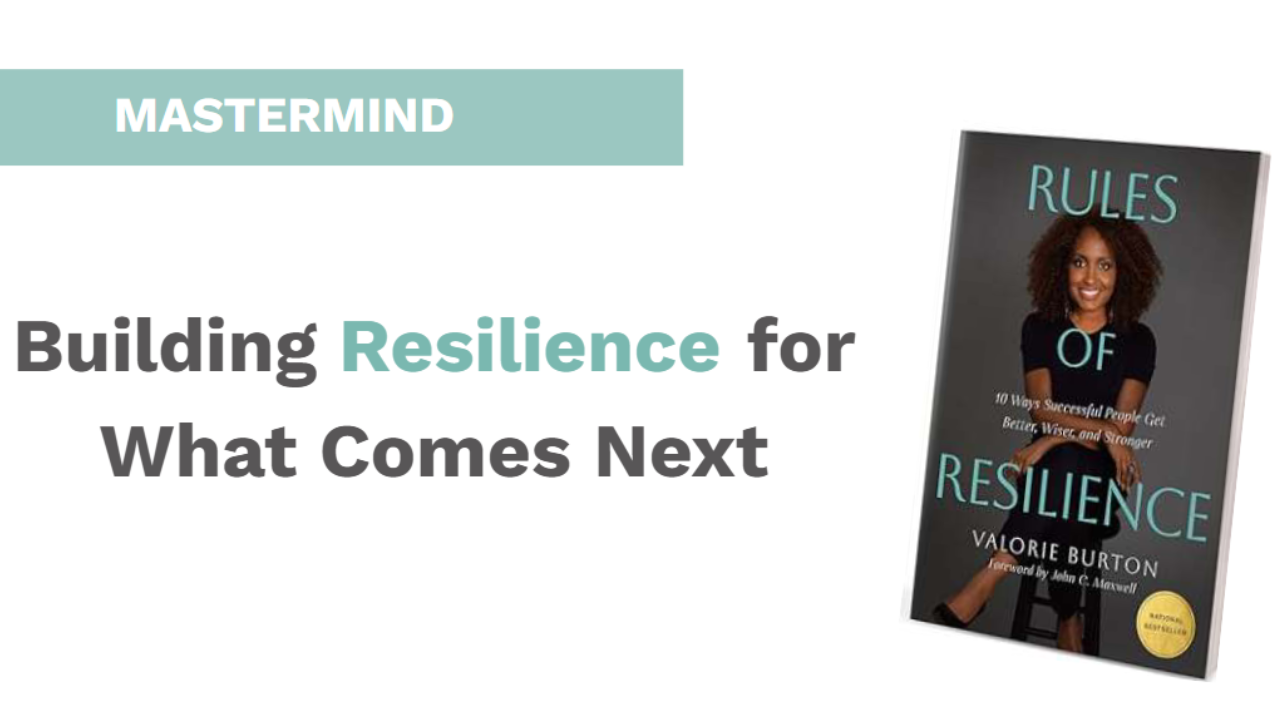
Rules of Resilience
A 12-session hope-informed mastermind: 10 Ways People Get Better, Wiser, and Stronger
Build a practical personal system for navigating challenge
Strengthen the thoughts, resources, and relationships that support resilience
Prepare for uncertainty without losing hope or perspective
Focus on what you can control and release what you cannot
Turn obstacles into learning, growth, and new opportunity
Know when to persevere—and when wisdom calls for a new direction
Protect your energy and reduce the risk of burnout
Programme overview
Rules of Resilience is a 12-session mastermind based on the work of Valorie Burton. It is designed to help participants develop the thoughts, behaviours, relationships, resources, and habits that enable them to navigate challenge with greater wisdom and strength.
The programme presents resilience not as a fixed personality trait or a matter of luck, but as a personal system that can be intentionally developed.
Participants explore three pillars that support resilience:
- Adaptive skills — the mental, emotional, and spiritual resources used to respond to challenge
- Protective resources — the relationships, structures, and support that help cushion adversity
- Preventive measures — the actions taken in advance to strengthen future readiness
Across the programme, participants learn how to prepare for the unexpected, choose strengthening thoughts, maintain focus on their vision, manage what is within their control, ask for support, close personal growth gaps, respond authentically, find opportunity in challenge, make wise decisions about perseverance, and protect the energy required for sustained resilience.
The facilitator guide presents a 12-session journey comprising an introductory resilience system, ten resilience rules, and a final bonus rule focused on paying resilience forward.
Programme Purpose
The purpose of this mastermind is to help participants:
- Understand resilience as a system that can be cultivated
- Assess their current resilience across different areas of life
- Strengthen adaptive, protective, and preventive resources
- Prepare more intentionally for both setbacks and opportunities
- Develop healthier and more accurate thought patterns
- Maintain perspective when facing obstacles
- Focus energy on what can be influenced or controlled
- Recognise when support, guidance, or additional resources are needed
- Identify gaps in knowledge, capability, or personal development
- Respond to challenge with honesty rather than pretence or defensiveness
- Find constructive meaning and possibility within difficult experiences
- Discern when persistence is wise and when change is necessary
- Protect physical, emotional, relational, and spiritual energy
- Use personal experiences to strengthen and encourage others
Programme Format
Duration: 12 sessions
Session length: Approximately 60 to 90 minutes
Delivery: Online
Format: Facilitated small-group mastermind
Core content: Licensed Maxwell Leadership content based on Valorie Burton’s Rules of Resilience
Each session may include:
- Reflection on the previous week’s application
- Facilitated exploration of a resilience principle
- Self-assessment and personal reflection
- Coaching-style questions
- Practical workplace and life application
- A resilience-building action commitment
- Peer support and accountability
- Recommended reading before the following session
The participant values highlighted in the guide include commitment, punctuality, focused presence, encouragement, willingness to contribute, and openness to learning from others.
The 12-Session Journey
Session 1: Create and Cultivate a Personal System of Resilience
The opening session reframes resilience as something participants can build rather than something they either possess or lack.
The “tipping the scales” model illustrates how resilience increases when adaptive skills, protective resources, and supportive relationships outweigh current stressors and challenges.
They identify their strongest and weakest resilience pillars and select one action that may strengthen the area needing the greatest support.
Session 2: Resilience Rule #1
Expect the Unexpected
This session helps participants prepare more intentionally for events they cannot predict.
Participants identify an area where they are currently underprepared and choose practical preventive actions to strengthen their readiness.
Session 3: Resilience Rule #2
Choose Thoughts That Strengthen You
This session focuses on the relationship between events, interpretations, emotions, and actions.
Participants explore the sequence:
Stressor → Thoughts → Reactions
The session emphasises that changing thoughts can influence both feelings and behaviour.
Session 4: Resilience Rule #3
Focus on the Vision, Not the Obstacle
Participants explore how a compelling vision can place immediate difficulties into perspective.
Participants may create or revise a vision in five areas:
- Relationships
- Work or career
- Finances
- Health
- Spiritual life
The programme introduces five stages of vision.
Participants identify what is possible, what the vision will require, what action to take, what to adjust, and how progress will eventually be celebrated.
Session 5: Resilience Rule #4
Control the Controllable, Accept the Rest
This session helps participants direct their energy towards what they can influence.
The session teaches that overfocusing on what cannot be controlled can undermine resilience, whereas taking responsibility for what can be influenced restores agency. The aim is to act responsibly while releasing the demand to control everything.
Session 6: Resilience Rule #5
Rally Your Resources
This session examines the resources participants need in order to face challenge effectively.
When people acknowledge what they need, they become better able to mobilise support they might otherwise reject.
Session 7: Resilience Rule #6
Close Your Growth Gap
This session focuses on the difference between current capability and what a future challenge or opportunity may require.
A growth gap is not approached as evidence of inadequacy. It becomes a practical invitation to learn, practise, seek feedback, and become better prepared.
Participants identify one growth priority and design an action such as reading, practising, requesting feedback, attending training, or seeking guidance.
Session 8: Resilience Rule #7
Don’t Pretend, Don’t Defend
This session explores the role of honesty, humility, and vulnerability in resilience.
The programme encourages participants to name what is true, seek the support they need, and remain teachable without allowing challenge to define their identity.
This rule is particularly valuable for leaders and high achievers who feel expected to appear strong at all times.
Session 9: Resilience Rule #8
Find the Opportunity in the Challenge
This session helps participants identify constructive possibilities without minimising genuine difficulty.
Participants apply these commitments to a current challenge and identify one constructive possibility or action.
Session 10: Resilience Rule #9
Know When to “Grit,” Know When to Quit
This session introduces discernment into conversations about perseverance.
The aim is to develop wise perseverance rather than automatically quitting or enduring at all costs.
Session 11: Resilience Rule #10
Close Your Energy Gap
This session explores the relationship between resilience and sustainable energy.
The programme emphasises that resilience requires more than determination. When demand continually exceeds available energy, progress becomes harder and the ability to recover weakens.
Participants identify their primary energy drains and create a practical replenishment plan that may include rest, movement, nutrition, supportive relationships, reflection, boundaries, reduced overload, and meaningful recovery.
Session 12: Bonus Rule
Pay It Forward
The final session considers how personal resilience can become a resource for others.
Participants may complete a personal resilience plan.
Key Themes Explored
Across the programme, participants explore:
- Adaptive skills
- Protective resources
- Preventive preparation
- Accurate optimism
- Thought awareness
- Vision and perspective
- Personal agency
- Acceptance
- Support and collaboration
- Continuous growth
- Vulnerability and authenticity
- Opportunity-focused thinking
- Wise perseverance
- Energy renewal
- Service and contribution
What Participants Can Expect to Gain
Participants may develop:
- A clearer understanding of their resilience level
- A practical personal resilience system
- Greater awareness of strengths and vulnerabilities
- Improved preparation for uncertainty
- More constructive thought patterns
- Increased ability to maintain perspective
- Greater personal agency
- Healthier acceptance of what cannot be controlled
- Increased willingness to ask for help
- A clearer development plan
- Greater openness to feedback
- Improved ability to identify opportunity within adversity
- Better judgement about when to persevere or change direction
- Stronger awareness of energy and burnout risk
- A practical resilience plan for future challenges
- Greater capacity to encourage and strengthen others
Who Should Attend?
This mastermind may be especially valuable for:
- Leaders and managers navigating uncertainty
- Teams working through change or pressure
- Professionals in demanding or deadline-driven environments
- Accountants and auditors facing prolonged peak seasons
- Business owners and entrepreneurs
- Emerging leaders
- People rebuilding after disappointment, loss, or transition
- Individuals experiencing ongoing stress
- Professionals wanting to prevent burnout
- People preparing for a significant new opportunity
- Teams wanting to develop a shared language around resilience
- Coaches, mentors, and people-development professionals
- Anyone wanting to become better, wiser, and stronger through challenge
Got any questions? You are welcome to contact Lynette Berger at [email protected]