A Maxwell Leadership Mastermind Programme
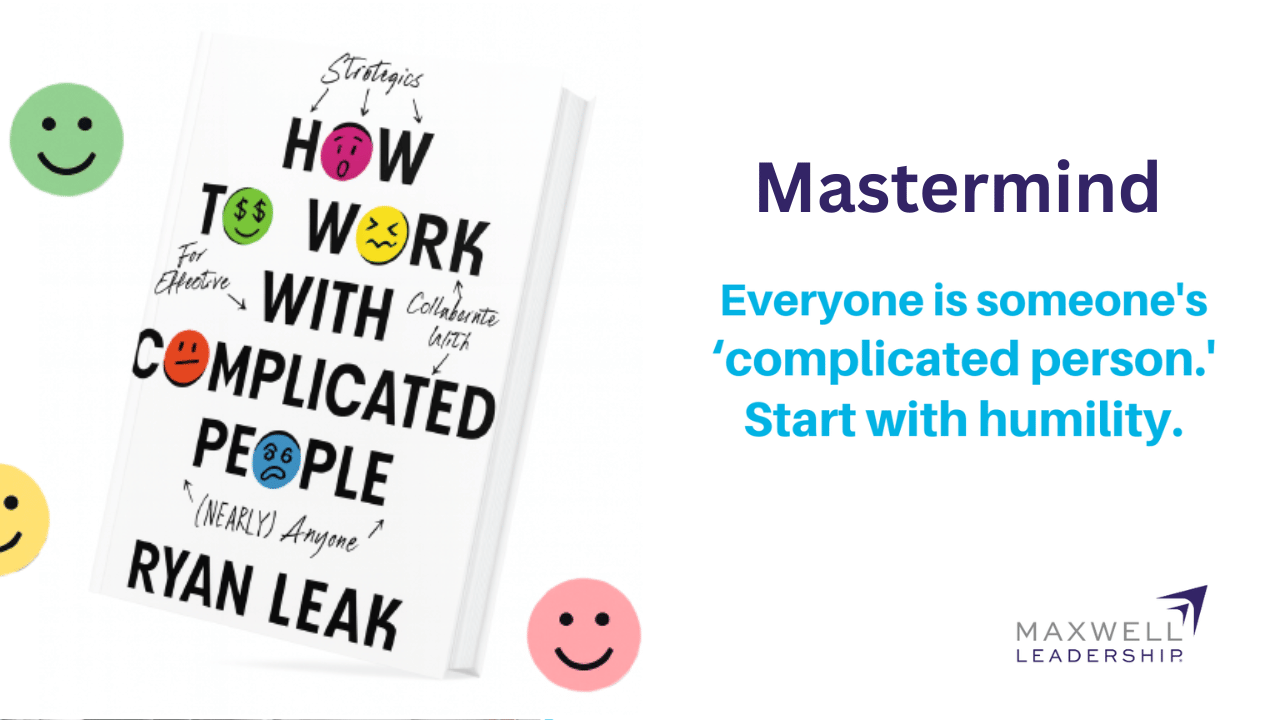
How to work with Complicated People
A 10-week interactive mastermind for leaders, professionals, and teams who want to achieve more together.
Understand what makes workplace relationships feel complicated
Recognise your triggers, assumptions, and relational blind spots
Replace frustration with curiosity and constructive action
Communicate more effectively across different styles and generations
Navigate difficult feedback, customers, and workplace dynamics
Strengthen collaboration without compromising healthy boundaries
Focus on the choices you can make—even when others do not change
Programme overview
How to Work with Complicated People is a practical relationship and collaboration mastermind based on the work of Ryan Leak.
The programme helps participants develop healthier, more productive ways of working with people whose personalities, priorities, communication styles, expectations, or behaviour they may find difficult.
Rather than focusing only on how to change other people, the mastermind invites participants to begin with self-awareness. They examine their own assumptions, expectations, triggers, communication habits, and contribution to challenging workplace dynamics.
Across 13 facilitated sessions, participants explore how to understand differences, regulate their responses, build bridges, communicate across different styles, handle difficult feedback and customers, and make constructive choices even when another person does not change.
The central aim is not to make every relationship easy. It is to help participants become more thoughtful, emotionally aware, adaptable, and effective in the way they collaborate with nearly anyone. The facilitator guide presents the programme as a 13-session journey, supported by group discussion, personal reflection, practical application, and between-session action.
Programme Purpose
The purpose of this mastermind is to help participants:
- Understand why certain workplace relationships feel complicated
- Recognise their own contribution to difficult interpersonal dynamics
- Replace frustration and judgement with curiosity and understanding
- Establish healthier and more realistic expectations
- Identify and regulate emotional triggers
- Communicate more effectively across personality and style differences
- Strengthen collaboration without avoiding necessary boundaries
- Respond more constructively to criticism, conflict, and disagreement
- Work more effectively across generational and cultural differences
- Improve relationships with colleagues, customers, and stakeholders
- Focus on the choices they can control when others do not change
Programme Format
Duration: 13 sessions
Session length: Approximately 60 to 90 minutes
Delivery: Online
Format: Facilitated small-group mastermind
Core content: Licensed Maxwell Leadership content based on Ryan Leak’s How to Work with Complicated People
Each session generally includes:
- Reflection on the previous week’s application
- Exploration of the assigned chapter
- Facilitated group discussion
- Personal and workplace reflection
- Practical relationship or collaboration tools
- An action commitment to apply before the next meeting
- Recommended chapter reading between sessions
Participants are encouraged to be committed, punctual, encouraging, ready to add value, willing to learn from others, and fully present during the group process.
The 13-Session Journey
Session 1: The Person You Need This Programme For
Participants begin by identifying the person or relationship they currently experience as complicated.
The session explores:
- What makes someone feel difficult to work with
- How challenging relationships affect productivity and well-being
- The limitations of avoiding, changing, or excluding people
- Why understanding is often more constructive than judgement
- The importance of looking at oneself before blaming others
A central reflection invites participants to consider what it may be like for others to work with them.
The session establishes that the goal is not to win against another person, but to build more successful and productive teamwork and collaboration.
Session 2: Good, Better, and Not-So-Bad News
This session reframes the challenge of working with complicated people.
The session highlights that challenging people may still bring valuable knowledge, strengths, and perspectives to a team.
Session 3: Stop Letting Them Surprise You
Participants explore the role that expectations play in frustration and conflict.
Participants learn that they may not be able to change another person, but they can clarify expectations and manage their own responses.
Session 4: Same Planet, Different Worlds
This session focuses on assumptions, bias, empathy, and perspective.
Participants consider how the stories they tell themselves about others may influence the relationship before meaningful interaction even takes place.
The session encourages participants to move from labelling others to seeking greater understanding.
Session 5: Collaboration as a Mindset
Participants explore four foundational elements of a healthy collaboration mindset:
Self-awareness
What is it like to be on the other side of me?
Ownership
What is my part to play?
Curiosity
What is it like to be you?
Connection
What brings us together?
These four questions help participants focus on what they can influence rather than waiting for someone else to change.
The session reinforces the importance of taking responsibility, understanding another person’s experience, and finding common ground.
Session 6: Developing Your People Qs
This session explores the different forms of intelligence and awareness needed to work effectively with people.
Participants consider how intelligence, emotional awareness, adaptability, and interpersonal understanding affect workplace collaboration.
Participants are encouraged to become “multilingual” in the workplace by learning how different people communicate, think, and engage.
Session 7: Age Is Just a Number—Until You Have to Work Together
This session addresses the realities of working across generations.
Participants explore how different generations may hold different views about:
- Communication
- Authority
- feedback
- Technology
- Loyalty
- Career progression
- Work-life boundaries
- Recognition and reward
The session encourages participants to move beyond generational stereotypes and engage with individuals more thoughtfully.
The focus is on building mutual respect, understanding the experiences that shaped different generations, and finding practical ways to work together effectively.
Session 8: Now You’re Speaking My Language
Participants examine how differences in communication can create unnecessary tension.
Participants are encouraged to take greater responsibility for whether their message is understood—not merely whether it was delivered.
Session 9: The Customer Is Not Always Right
This session explores how to respond constructively to complicated or dissatisfied customers and stakeholders.
The programme encourages participants to look for the possible value within negative feedback while also discerning which criticism is valid and which should be released.
Session 10: Don’t Shoot the Messenger
Participants explore how people respond when they receive information they do not want to hear.
Participants reflect on whether colleagues feel able to speak honestly with them and how their reactions shape future communication.
Session 11: Putting the “Nearly” in Nearly Anyone
This session introduces a necessary distinction: effective collaboration does not mean that every relationship can or should be preserved at any cost.
This session helps balance empathy with responsibility and healthy boundaries.
Session 12: Choices That Change You, Even If People Stay the Same
Participants explore the choices available to them when another person does not change.
The emphasis is on growth that does not depend on another person’s cooperation.
Session 13: Conclusion and Personal Collaboration Plan
The final session brings the learning journey together.
Participants may complete a personal action plan identifying:
- One relationship to approach differently
- One communication habit to strengthen
- One assumption to challenge
- One boundary to clarify
- One commitment to carry forward
Core Themes Explored
Across the programme, participants explore:
- Self-awareness and personal ownership
- Expectations and emotional triggers
- Empathy and perspective-taking
- Workplace communication
- Collaboration across differences
- Generational understanding
- Customer and stakeholder relationships
- Feedback and psychological safety
- Assumptions, bias, and workplace narratives
- Healthy boundaries
- Emotional maturity
- Personal choice and responsibility
What Participants Can Expect to Gain
Participants may develop:
- Greater awareness of how they affect others
- Improved emotional self-management
- Healthier expectations of colleagues and team members
- Increased empathy and relational curiosity
- More adaptable communication skills
- Better capacity to handle disagreement
- Greater confidence in difficult conversations
- Improved collaboration across personality and generational differences
- More constructive responses to criticism
- Stronger interpersonal boundaries
- Reduced frustration and emotional exhaustion
- A practical plan for improving challenging workplace relationships
Who Should Attend?
This mastermind is suitable for:
- Leaders and managers
- Supervisors and team leaders
- Emerging leaders
- Human resources and people-development professionals
- Client-facing professionals
- Customer service teams
- Project and cross-functional teams
- Professionals navigating workplace conflict
- Teams experiencing communication or relationship strain
- Individuals wanting to strengthen their interpersonal effectiveness
The programme is especially relevant in workplaces where people must continue collaborating despite different personalities, expectations, values, working styles, or perspectives.
Got any questions? You are welcome to contact Lynette Berger at [email protected]